People often arrive at emotional learning with a familiar declaration: “I need to change.”
Sometimes they add, “I have been trying so hard,” or “Other people seem to manage their emotions better than I do.”
These statements express a desire for relief. They may also reveal the very process that makes relief difficult: an individual is observing a feeling, comparing it with an expected feeling, and judging the difference. Anxiety becomes evidence of inadequacy. Anger becomes evidence of failure. Another difficult day becomes proof that the person has not changed enough.
In the approach I call Emotional Intelligence Improvement, or Ei, we begin with a different invitation: become curious.
We do not change in Ei. We do not try in Ei. We do not compare ourselves in Ei. We are motivated through curiosity.
These statements describe the attitude we bring to learning. They do not mean that behavior remains fixed, practice is unnecessary, or outcomes cannot be evaluated. They mean that we do not make rejection of ourselves the price of learning about ourselves. We investigate our experience, develop skills, and allow different responses to emerge from what we understand and practice.
Curiosity gives us something useful to do before we demand a different result.
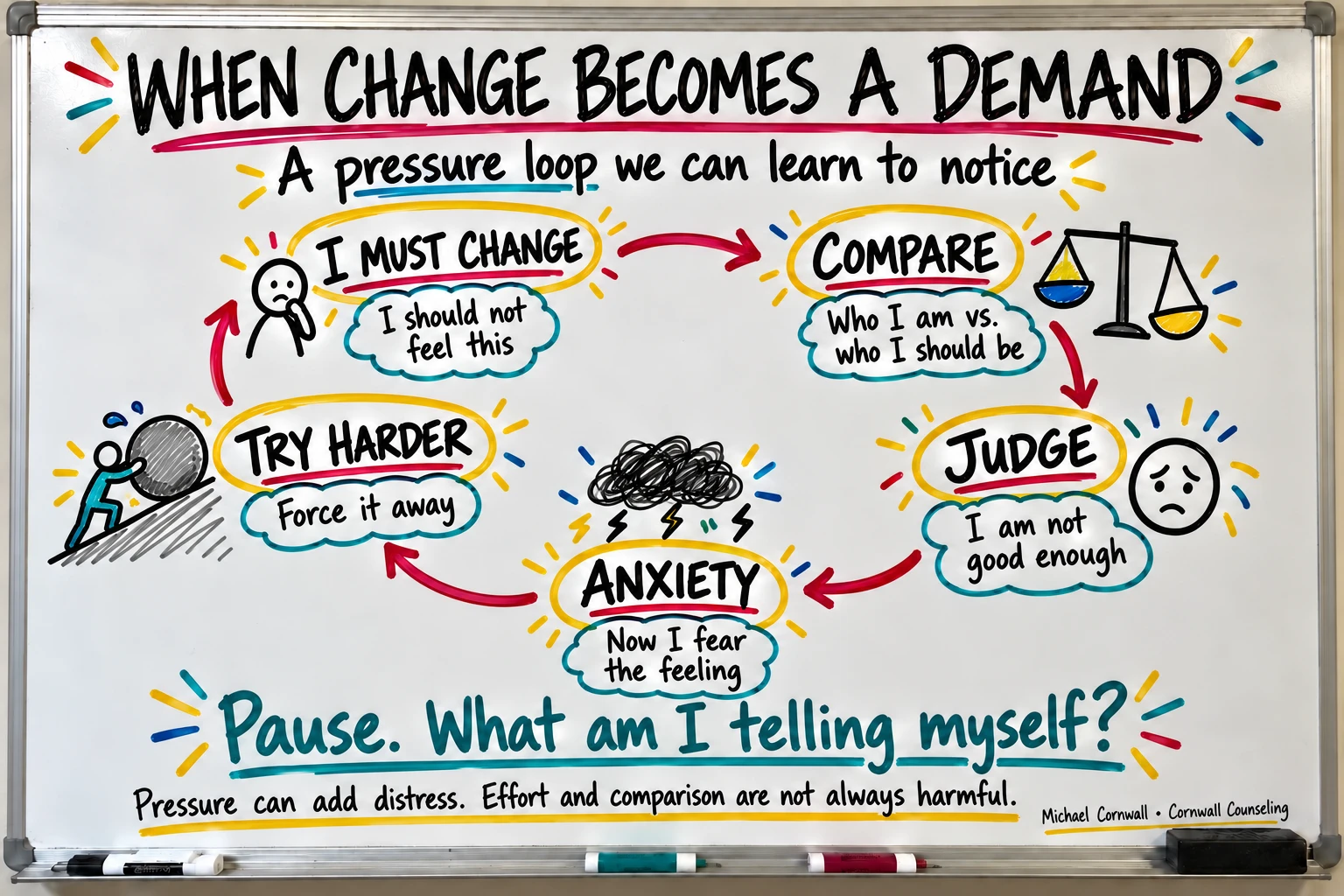
The pressure hidden inside the demand to change
“I want to understand my anxiety” and “I must stop being anxious” may sound like similar goals. Yet they give the individual different assignments.
The first invites observation. The second establishes a requirement.
When the requirement becomes rigid, a person may begin monitoring every sensation for evidence that the requirement has been met. A racing heart is no longer simply uncomfortable; it becomes evidence that the person is failing. The individual may then become afraid of being afraid.
Consider this internal conversation:
“I should be over this.”
“But I am anxious.”
“Then something must be wrong with me.”
Now there are two difficulties to address: the original fear and the judgment attached to having it.
Research by Ford and colleagues (2018) found that accepting thoughts and emotions without judging them was associated with better psychological health. Their laboratory, diary, and longitudinal findings suggest that reduced negative emotional responses to stressors help explain this relationship. This supports making room for an experience without adding condemnation to it.
Within Ei, the practical question becomes: What can I learn from this experience before I decide that it should not exist?
The difficulty is not the word “change” itself. A flexible wish to develop a skill can be useful. The difficulty arises when a wish becomes a demand and the demand becomes a judgment of the whole person.
How comparison can turn learning into a test
The instruction to change commonly involves a comparison between the present and a preferred future. There is the person I am experiencing myself to be and the person I believe I should already be.
That difference can provide information. It can also become threatening when it is interpreted as evidence of inferiority.
“I noticed that I interrupted three times” describes behavior.
“I am less emotionally intelligent than everyone else” ranks the person.
The first statement provides something specific to investigate. The second can leave the individual defending, condemning, or proving themselves.
Ei does not require that we stop noticing differences. We can notice that a conversation was calmer, that an apology came sooner, or that we asked a question before making an accusation. These observations help us understand what works. They do not have to become a scoreboard of personal worth.
The distinction matters because comparison is not inevitably harmful. In experiments by Breines and Chen (2012), self-compassion increased several forms of motivation following mistakes or perceived weaknesses; in one experiment it also increased interest in upward comparison. The evidence therefore does not support declaring every comparison damaging.
The Ei principle is more specific: we do not use comparison to determine our acceptability. We examine responses and consequences while accepting the person who is doing the learning.
Why trying harder may leave us without a method
“I am trying” can express sincerity, willingness, and considerable effort. But it does not necessarily identify a skill.
Someone may try to be less angry while repeatedly rehearsing how unfairly they were treated. Someone may try to stop worrying while repeatedly imagining the outcome they fear. Someone may try to feel confident while checking for evidence that they are inadequate.
The effort is real. The process may be working against the desired result.
Curiosity makes the assignment more specific.
“What am I telling myself about this?”
“What outcome am I predicting?”
“What am I demanding that another person do?”
“What do I believe it would mean if I were disappointed?”
These questions give attention a direction. Instead of straining toward an emotional result, the individual begins examining the process associated with that result.
Research on emotion regulation illustrates why method matters. Gross (1998) found different consequences when participants reinterpreted an upsetting stimulus and when they suppressed outward emotional expression. Both reduced expressive behavior, but their effects on emotional experience and physiological activation differed. Effort alone does not tell us whether a strategy is useful.
When we say that we do not try in Ei, we are not dismissing effort. We are replacing the vague instruction to try harder with the concrete work of observing, questioning, practicing, and reviewing.
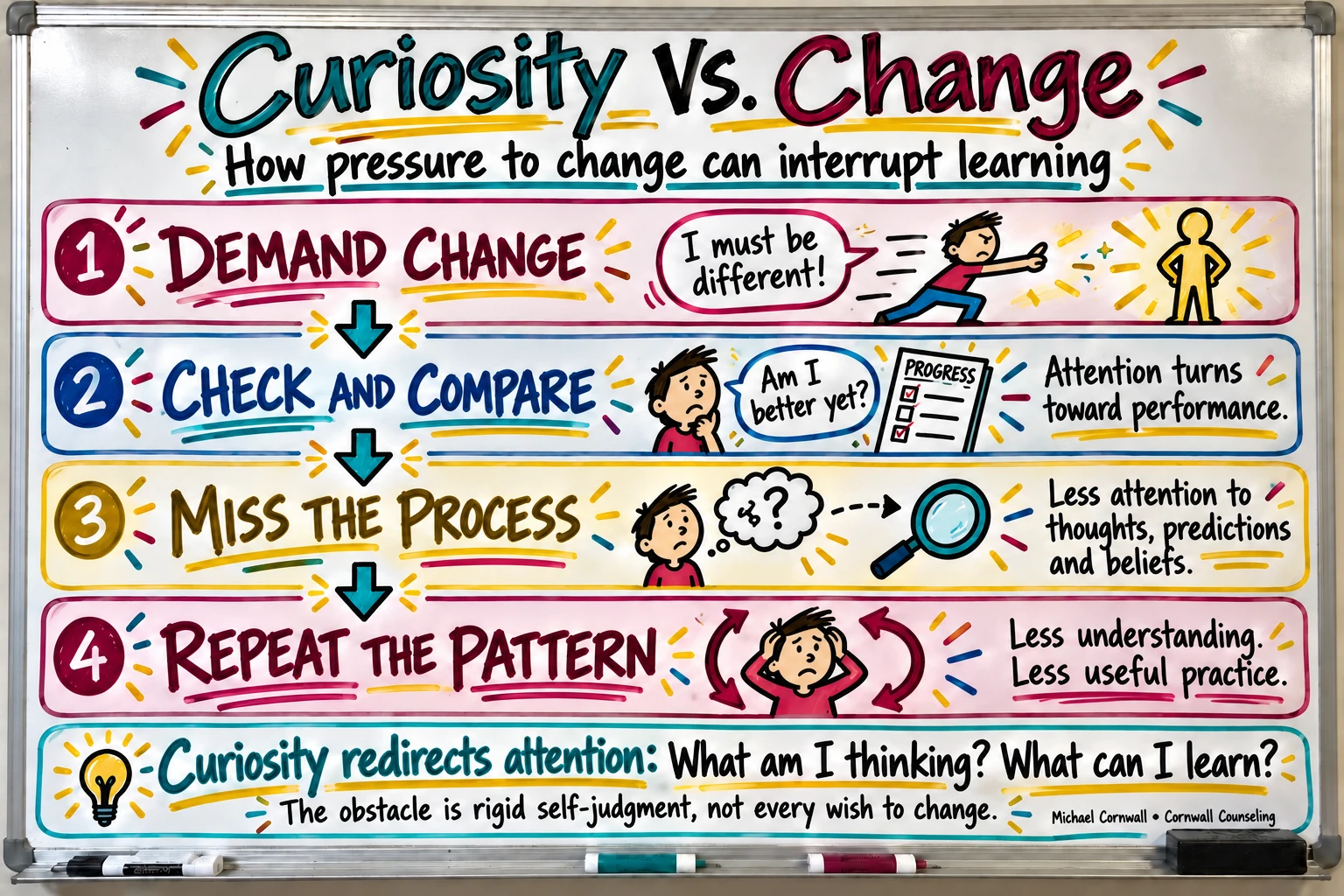
Curiosity helps us hear the thoughts inside fear
Fear often arrives as a conclusion: “Something is wrong.”
Curiosity asks what the conclusion contains.
Imagine sending a message and receiving no reply. The observable event is limited: a reply has not arrived. The mind may quickly supply a larger account.
“They are upset with me.”
“I must have said something foolish.”
“They are going to leave.”
“I could not bear that.”
The person may experience these statements as though they are descriptions of an established reality. Curiosity creates an opportunity to notice that they include interpretations, predictions, and beliefs about coping.
“What do I actually know?”
“What am I filling in?”
“How certain am I?”
“If the disappointing possibility occurred, what help or choices would be available?”
The purpose is not to replace every unpleasant possibility with a pleasant one. A delayed reply might reflect a problem. Curiosity allows us to consider that possibility without immediately treating it as fact or assuming that we would be unable to respond.
Within Ei, I describe emotion as an animation of thought: the meaning we give an experience can become emotionally vivid and physically compelling. This is a teaching phrase, rather than a complete scientific account of emotion. Emotional experience also involves bodily processes, learning history, relationships, and circumstances; a conscious sentence is not always available before a feeling appears.
Curiosity therefore investigates the whole experience. It does not accuse someone of deliberately causing their distress. Responsibility for learning a response is different from blame for having one.
Self awareness involves more than noticing discomfort
“I know I am anxious” is useful awareness. It may not yet explain what to do next.
A fuller investigation might sound like this:
“My chest feels tight. I am predicting that I will be criticized. I am treating criticism as proof that I am inadequate. I want to cancel the meeting so I do not have to experience that possibility.”
Now the individual has identified a sensation, a prediction, a personal meaning, and an urge to act. Each provides a possible place to practice a skill.
Naming an emotional experience can itself be useful. Lieberman and colleagues (2007) found that labeling emotions in a laboratory task was associated with reduced amygdala responses to negative emotional images. This finding supports a role for putting feelings into words; it does not mean that naming any feeling will reliably remove it.
Ei asks us to become more accurate observers. “I am falling apart” may be the first description that comes to mind. With curiosity, a person may discover a more specific account: “I am frightened about a conversation, and I am predicting humiliation.”
The more specific description gives us a clearer question to examine.
Curiosity needs room for uncertainty
A curious person does not need an immediate answer to every question.
Sometimes the honest response is, “I do not know why this feeling appeared.” Sometimes several influences are involved. Sometimes understanding becomes clearer after rest, a conversation, or a later experience.
This willingness matters because an investigation can become another demand.
“I must understand this feeling immediately” can create the same pressure as “I must get rid of this feeling immediately.”
Research on curiosity distinguishes seeking new knowledge from willingness to engage with novelty and uncertainty. Kashdan and colleagues (2009) found that these aspects of curiosity were associated with qualities including psychological flexibility and self-acceptance. Their study supports a connection among these qualities, rather than proving that curiosity causes lasting emotional improvement.
The application to Ei is an inference: openness may make investigation easier because an unanswered question does not have to be treated as an emergency.
Curiosity can say, “There is more to learn here,” and allow the individual to continue living while learning it.
Curiosity differs from repetitive self interrogation
An individual can ask many questions without becoming more curious.
“Why am I always like this?”
“Why can everyone else cope?”
“What if this never gets better?”
These questions may sound investigative while repeatedly returning the person to a judgment or feared conclusion.
Useful curiosity is willing to discover something unfamiliar. It becomes specific enough to inform a response.
“What happened immediately before I wanted to leave?”
“What did I predict?”
“What happened when I stayed for another five minutes?”
“What would I like to practice next time?”
Watkins (2008) reviewed evidence that repetitive thinking can be constructive or unconstructive depending on factors including context, content, and whether processing is abstract or concrete. This helps explain why thinking more about a problem does not necessarily mean understanding it better.
In Ei, curiosity does not require endless analysis. If questioning becomes repetitive and yields no new information, we can redirect attention to the present task, seek support, or return to the question later.
We are allowed to leave an investigation unfinished.
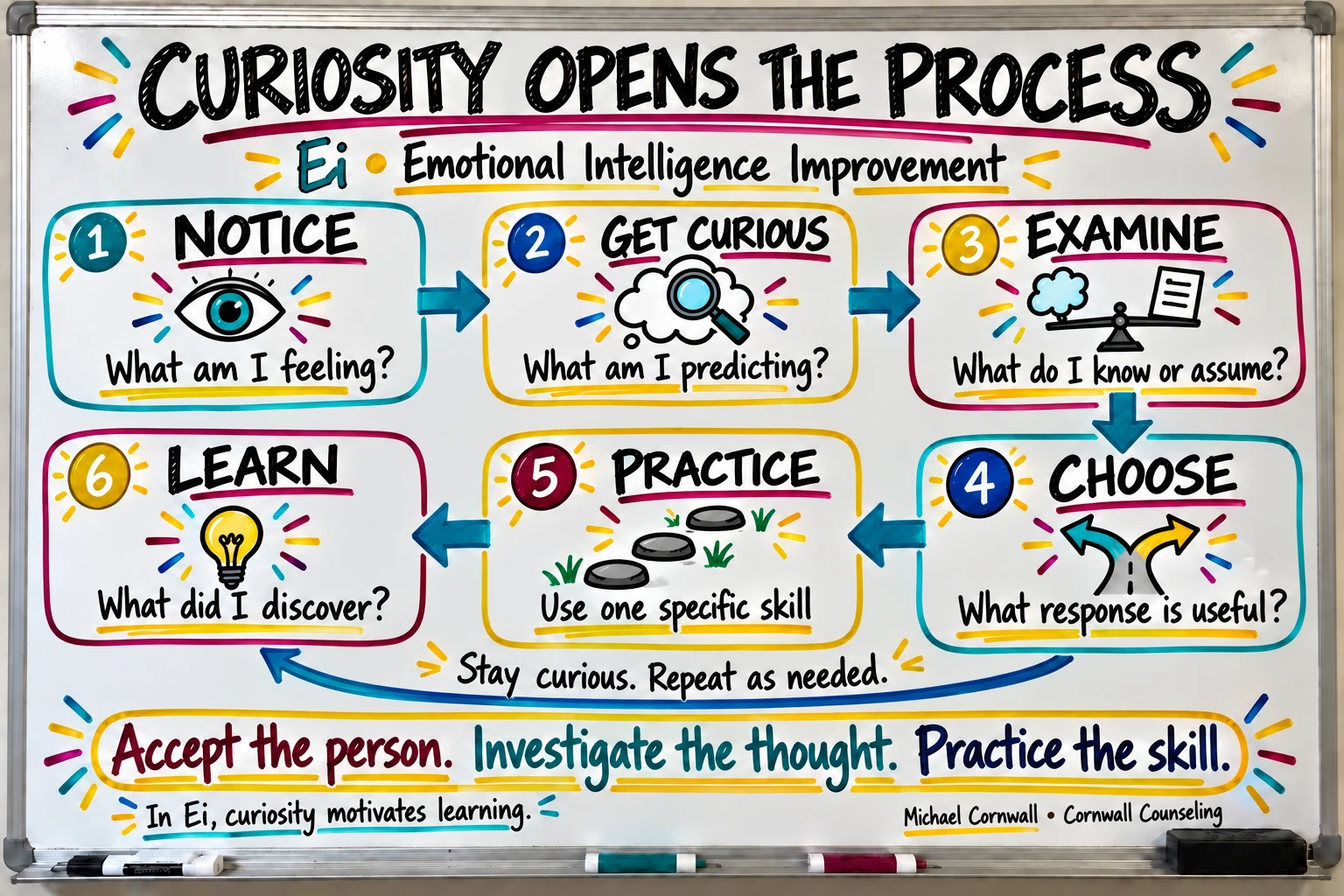
Understanding becomes useful through practice
Awareness creates opportunities, but insight alone does not guarantee a different response.
A person may recognize a fear of rejection and continue seeking reassurance. Another may identify a rigid demand and repeat it during the next disagreement. Knowing the pattern is a beginning.
Curiosity can guide an experiment.
Someone who fears disagreement might practice asking, “Can you explain how you see it?” before defending their position. Someone who predicts humiliation might attend a meeting, contribute one question, and observe what actually occurs. Someone who sends repeated reassurance messages might pause before sending another and notice the thoughts accompanying the urge.
These are actions. They involve effort and sometimes discomfort. The Ei distinction concerns the reason for acting: we practice to learn, rather than to prove that we have become an acceptable person.
Afterward, we review the experience.
“What did I predict?”
“What occurred?”
“What did I learn?”
“What would make the next practice more useful?”
A difficult outcome can provide information. It does not have to erase the value of the investigation.
Lasting results require opportunities to use skills across situations. Curiosity helps keep that practice open to revision when life does not follow our expectations.
Self acceptance leaves room for accountability
Some people fear that accepting themselves will remove their motivation.
The Ei position is that self-acceptance permits an honest examination of behavior without making that examination a trial of personal worth.
“I shouted” can be acknowledged directly.
“I frightened someone” can be taken seriously.
“I need to apologize, repair what I can, and practice a different response” can lead to action.
None requires the conclusion, “I am a worthless person.”
The findings of Breines and Chen (2012) are relevant here: compassionate responses to mistakes supported motivation to make amends and engage in improvement. Acceptance need not mean complacency.
Curiosity also does not require accepting mistreatment or remaining in danger. Emotional management may involve setting a boundary, leaving a situation, obtaining practical assistance, or seeking professional care. Understanding our interpretation of an event does not make the event harmless.
We can accept ourselves while taking our conduct, our circumstances, and other people’s needs seriously.
A different starting point for emotional learning
The central invitation of Ei is to become interested in how we experience our lives.
When fear appears, we can investigate its predictions. When anger appears, we can examine expectations and perceived threats. When shame appears, we can listen for the judgment we have made about ourselves. We can also notice exhaustion, pain, environmental pressures, and unmet practical needs.
We do not need to condemn the experience before examining it.
The principles “we do not change,” “we do not try,” and “we do not compare” are reminders about this starting point. They protect learning from becoming another demand for perfection. They invite us to describe what is happening, practice a useful response, and remain open to what follows.
Research supports several ingredients of this approach, including acceptance, emotional labeling, and openness. It does not establish that this Ei framework is universally superior to every approach organized around change. The argument is a practical synthesis: curiosity can provide a more useful starting point when demands for change, vague effort, and judgmental comparison are themselves adding distress.
A different response may develop through that learning. We may pause sooner, communicate more clearly, tolerate uncertainty, or recover more readily after disappointment. Those outcomes matter. They need not become conditions of self-acceptance.
In Ei, we begin with curiosity. We learn how we are thinking, what we are predicting, and how we are responding. Then we practice with what we discover.
The invitation is simple: “I wonder what I can learn here.”
References
Breines, J. G., & Chen, S. (2012). Self-compassion increases self-improvement motivation. Personality and Social Psychology Bulletin, 38(9), 1133–1143. https://doi.org/10.1177/0146167212445599
Ford, B. Q., Lam, P., John, O. P., & Mauss, I. B. (2018). The psychological health benefits of accepting negative emotions and thoughts: Laboratory, diary, and longitudinal evidence. Journal of Personality and Social Psychology, 115(6), 1075–1092. https://doi.org/10.1037/pspp0000157
Gross, J. J. (1998). Antecedent- and response-focused emotion regulation: Divergent consequences for experience, expression, and physiology. Journal of Personality and Social Psychology, 74(1), 224–237. https://doi.org/10.1037/0022-3514.74.1.224
Kashdan, T. B., Gallagher, M. W., Silvia, P. J., Winterstein, B. P., Breen, W. E., Terhar, D., & Steger, M. F. (2009). The Curiosity and Exploration Inventory-II: Development, factor structure, and psychometrics. Journal of Research in Personality, 43(6), 987–998. https://doi.org/10.1016/j.jrp.2009.04.011
Lieberman, M. D., Eisenberger, N. I., Crockett, M. J., Tom, S. M., Pfeifer, J. H., & Way, B. M. (2007). Putting feelings into words: Affect labeling disrupts amygdala activity in response to affective stimuli. Psychological Science, 18(5), 421–428. https://doi.org/10.1111/j.1467-9280.2007.01916.x
Watkins, E. R. (2008). Constructive and unconstructive repetitive thought. Psychological Bulletin, 134(2), 163–206. https://doi.org/10.1037/0033-2909.134.2.163
