Much of mental health advice is organized around self-improvement. We are encouraged to correct our thinking, behavior, habits, relationships, bodies, reactions, and ultimately become better versions of ourselves. Although growth can be valuable, this language can quietly carry a troubling assumption: Who I am now is inadequate, and I should become someone else.
Once that assumption takes hold, personal development can become less about discovery and more about correction. Improvement becomes an emergency. There is somewhere else we are supposed to be, something else we should have accomplished, or someone else we should resemble. Instead of examining ourselves, we begin measuring ourselves.
Curiosity offers a substantially different approach.
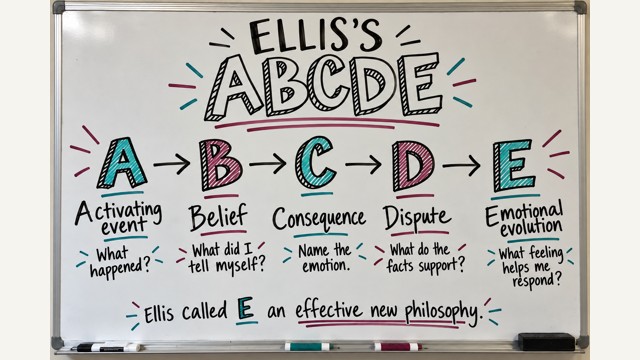
Curiosity asks, What is happening here? It asks, What was I thinking when I reacted that way? How did I make myself feel this way? What am I afraid this means? What happens when I respond differently? Curiosity does not initially require improvement. It requires attention.
That distinction may be extraordinarily important in mental health management. Curiosity permits a person to examine thoughts, emotions, and behaviors without immediately declaring them defective. Rather than beginning with the command I need to fix this, the person begins with a question: How did I arrive at this response?
Psychological research provides considerable support for this orientation. Curiosity has been conceptualized as a motivational process involving the pursuit of new information and a willingness to engage with uncertain or unfamiliar experiences (Kashdan et al., 2009). Importantly, curiosity is associated not merely with novelty seeking but with personal growth, openness, autonomy, purpose, self-acceptance, and psychological flexibility (Kashdan et al., 2009). These associations suggest that curiosity can contribute to development without requiring a person to begin from a position of self-condemnation.
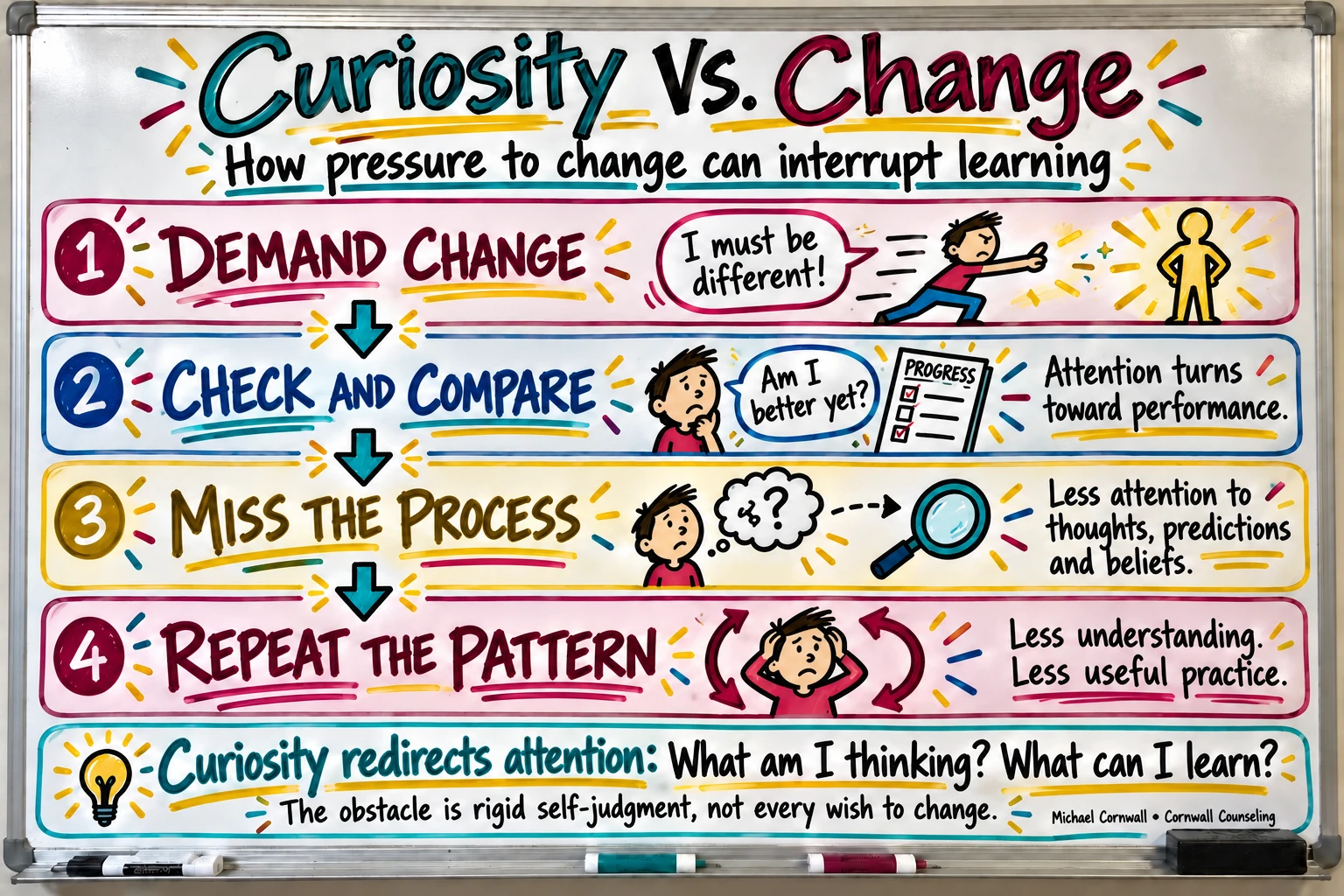
This is where curiosity differs from many common approaches to self-improvement. Curiosity says, Let me understand myself. Comparison says, Let me determine whether I measure up.
Comparison requires a standard. Sometimes the standard is another person. Sometimes it is an imagined future self. Sometimes it is a younger version of oneself. Sometimes it is a cultural expectation about attractiveness, success, wealth, intelligence, relationships, productivity, health, or emotional composure. Whatever standard is chosen, comparison divides experience into two positions: where I am and where I believe I should be.
The distance between those positions can easily become distress.
Social comparison is not inherently pathological. Human beings naturally evaluate themselves partly through information obtained from other people. Comparison can occasionally provide useful information, motivation, reassurance, or perspective. Nevertheless, research demonstrates that certain forms of comparison—particularly unfavorable upward comparison—are associated with poorer emotional outcomes. A systematic review and meta-analysis found substantial associations between social comparison processes and both depression and anxiety in clinical populations (McCarthy & Morina, 2020). More recent reviews likewise emphasize that the mental-health consequences of comparison depend on how individuals interpret and respond to the comparison rather than comparison being universally harmful (Arigo et al., 2024).
The problem, therefore, is not that we ever notice other people. The problem begins when another person's life becomes evidence against our own.
Someone is thinner, younger, wealthier, happier, further ahead, more educated, more attractive, more successful, more disciplined, less anxious, or apparently more emotionally stable. The observation is converted into a conclusion: I should be more like that.
And from should comes urgency.
Urgency is one of the least examined aspects of self-improvement. The person is no longer simply interested in development. There is now something wrong that must be corrected. Improvement becomes a deadline without a date.
I should be further along by now. I have to get over this. I need to stop feeling this way. I shouldn't still have this problem. I need to become better.
These statements appear motivational, but emotionally they can function as threats. They transform ordinary human fallibility into evidence of failure.
Perfectionism research illustrates the danger. Perfectionistic concerns—including excessive concern about mistakes, self-evaluation, and perceived failure to meet standards—show meaningful associations with depression and anxiety. A large systematic review and meta-analysis involving more than 113,000 adults found moderate associations between perfectionistic concerns and symptoms of depression, anxiety, and obsessive-compulsive disorder (Callaghan et al., 2024). Longitudinal evidence also suggests a reciprocal relationship between perfectionistic concerns and depressive symptoms: perfectionism can contribute to depressive symptoms, while depressive symptoms may subsequently intensify perfectionistic concerns (Smith et al., 2021).
The pursuit of being better can therefore become psychologically expensive when being better is secretly defined as being acceptable.
Suppose someone repeatedly becomes anxious before social situations. An urgency-oriented internal conversation may sound like this: How did I make myself feel this way? I should be more confident. Other people don't have this much trouble. I need to stop being anxious.
Curiosity reframes the conversation: Interesting. My anxiety seems to increase before situations where I believe I might be evaluated. What am I predicting will happen? What am I telling myself another person's judgment would mean about me?
Nothing has been excused. Nothing has been denied. But something important has shifted. The individual has moved from prosecution to investigation.
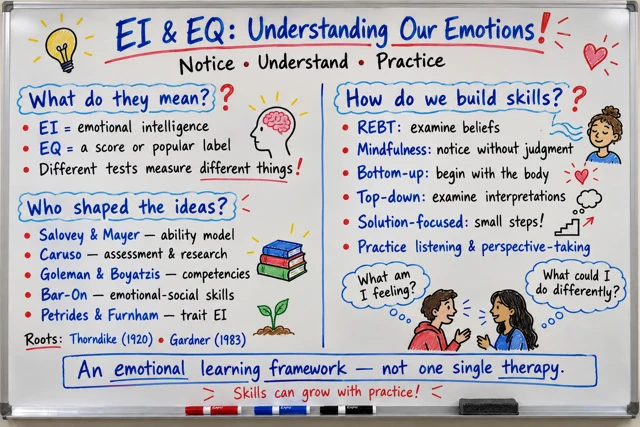
That shift is consistent with emotional intelligence. Emotional intelligence involves capacities related to perceiving, understanding, using, and managing emotional information (Mayer et al., 2004). Managing emotion does not require immediately suppressing or eliminating it. Contemporary work examining emotional intelligence and emotion regulation instead emphasizes how emotional information can be recognized, understood, and responded to more deliberately (Xiao et al., 2026).
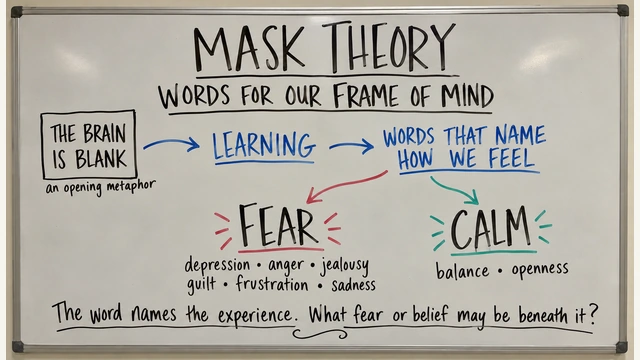
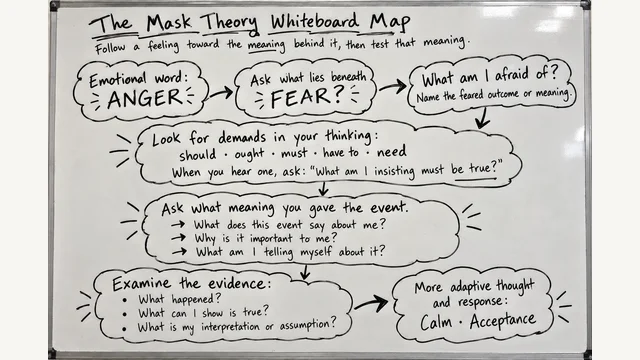
Curiosity is particularly useful here because emotions contain information. An emotion can become an invitation to investigate the thinking behind it. Instead of asking, How do I get rid of this feeling? one might ask, What am I thinking that makes this feeling reasonable to me?
That question creates room between experience and reaction.
Anxiety, for example, frequently contains prediction. Anger frequently contains judgment. Shame frequently contains a conclusion about personal worth. Jealousy may contain comparison. Guilt may contain an evaluation of behavior. Sadness may contain an appraisal of loss. Emotional intelligence therefore benefits from curiosity because curiosity allows us to examine the architecture beneath emotional experience rather than merely fighting its visible expression.
This does not mean endlessly analyzing every feeling. Curiosity can become rumination if questioning turns into repetitive searching for certainty. Healthy curiosity is exploratory rather than prosecutorial. It observes, tests, learns, and eventually moves on.
Psychological flexibility provides an important conceptual companion to this idea. Psychological flexibility refers broadly to the capacity to remain in contact with present experience while continuing to act in ways that serve important values. Research has increasingly identified psychological flexibility as an important process associated with mental health and therapeutic improvement. A large meta-analytic review found that increases in psychological flexibility and decreases in psychological inflexibility during Acceptance and Commitment Therapy were associated with reductions in psychological distress (Macri & Rogge, 2024).
This suggests an alternative to the relentless project of becoming someone else.
Perhaps mental health is not primarily the achievement of an improved identity. Perhaps it is the development of a more flexible relationship with the identity one already has.
Acceptance becomes essential in that relationship.
Acceptance is sometimes misunderstood as resignation. It is nothing of the sort. Resignation says, Nothing can be done. Acceptance says, This is what exists at this moment, whether I like it or not.
Without acceptance, psychological energy is frequently spent arguing with reality: I shouldn't be anxious. I shouldn't have made that mistake. I shouldn't be getting older. I shouldn't have this limitation. That person shouldn't have treated me that way. My life should have turned out differently.
Some of these objections may be entirely understandable. Some may even be morally justified. But reality remains unimpressed by our objections to its existence.
Acceptance allows us to begin where we actually are.
Research on emotion regulation supports this position. In a meta-analysis involving people with mental disorders, acceptance showed a positive association with well-being, whereas avoidance and rumination were negatively associated with well-being (Kraiss et al., 2020). Similarly, research on self-compassion suggests that reduced self-judgment and greater self-kindness are related to lower psychological distress and greater well-being (Chio et al., 2021).
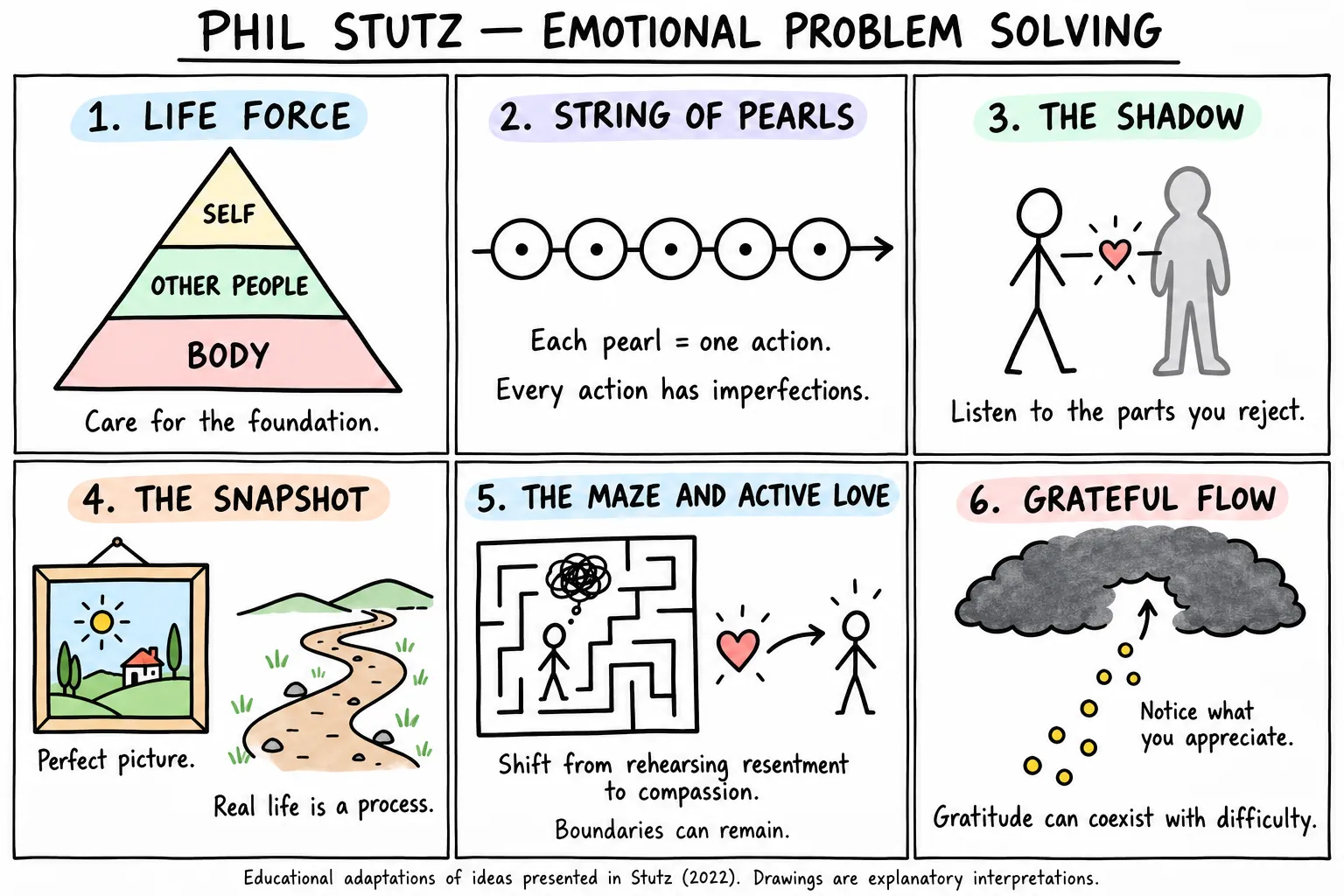
Curiosity and acceptance therefore work particularly well together. Acceptance says, This is happening. Curiosity asks, What can I learn from it? Neither requires the conclusion, Therefore, there is something wrong with me.
This position also leaves room for fallibility, which may be one of the most psychologically protective permissions a person can grant himself or herself. To be fallible is to accept that intelligence does not prevent foolish decisions, emotional maturity does not prevent emotional reactions, experience does not prevent mistakes, and psychological knowledge does not eliminate psychological vulnerability.
Fallibility is not a defect in being human. It is part of the definition.
People will occasionally overreact. They will misunderstand situations. They will become anxious about things that never happen. They will say things they wish they had not said. They will trust people they should not have trusted and distrust people who deserved more confidence. They will occasionally know better and still behave badly.
Curiosity allows these moments to become information rather than indictments. That did not go particularly well. What happened? This question is enormously different from: What is wrong with me?
The first question can produce learning. The second frequently produces a label.
Paradoxically, accepting fallibility may produce more durable learning than demanding perfection. When mistakes do not threaten one's entire self-concept, they can be examined more accurately. Defensiveness becomes less necessary. A person who does not need to prove that he or she is good can more easily admit to having behaved badly. A person who does not need to be right can become curious about being wrong. A person who does not need to appear psychologically healthy can acknowledge distress before it becomes unmanageable.
This is how curiosity may produce something more durable than comparison as a vehicle for personal development.
Comparison is externally anchored. Its standards move. There will always be someone younger, richer, thinner, stronger, calmer, more accomplished, more attractive, or apparently happier. Even comparison with one's idealized future self creates instability because the ideal can always be moved further away.
Curiosity has no finish line. It asks us to remain interested in ourselves.
The objective is therefore not to eliminate growth. Human beings continually develop through experience, relationships, education, loss, success, age, and insight.
But growth can be the result of understanding rather than the price of self-acceptance.
That reversal matters.
That is a much less urgent proposition.
Perhaps mental health management can sometimes be reduced to four permissions:
Emotional intelligence does not have to mean becoming a person who manages every emotion perfectly. It may mean becoming sufficiently curious about emotional experience that feelings no longer have to be feared, obeyed, suppressed, or judged.
The aim is not to become someone else.
The aim is to know the person who is already here well enough to live deliberately.
Curiosity makes that possible because it replaces the verdict with a question.
And a good question usually leaves more room for growth than a judgment ever will.
References
Arigo, D., Bercovitz, I., Lapitan, E., & Gular, S. (2024). Social comparison and mental health. Current Treatment Options in Psychiatry, 11, 17–33.
Callaghan, T., Greene, D., Shafran, R., Lunn, J., & Egan, S. J. (2024). The relationships between perfectionism and symptoms of depression, anxiety and obsessive-compulsive disorder in adults: A systematic review and meta-analysis. Cognitive Behaviour Therapy, 53(2), 121–132. https://doi.org/10.1080/16506073.2023.2277121
Chio, F. H. N., Mak, W. W. S., & Yu, B. C. L. (2021). Meta-analytic review on the differential effects of self-compassion components on well-being and psychological distress: The moderating role of dialecticism on self-compassion. Clinical Psychology Review, 85, 101986. https://doi.org/10.1016/j.cpr.2021.101986
Kashdan, T. B., Gallagher, M. W., Silvia, P. J., Winterstein, B. P., Breen, W. E., Terhar, D., & Steger, M. F. (2009). The Curiosity and Exploration Inventory-II: Development, factor structure, and psychometrics. Journal of Research in Personality, 43(6), 987–998. https://doi.org/10.1016/j.jrp.2009.04.011
Kraiss, J. T., ten Klooster, P. M., Moskowitz, J. T., & Bohlmeijer, E. T. (2020). The relationship between emotion regulation and well-being in patients with mental disorders: A meta-analysis. Comprehensive Psychiatry, 102, 152189. https://doi.org/10.1016/j.comppsych.2020.152189
Macri, J. A., & Rogge, R. D. (2024). Examining domains of psychological flexibility and inflexibility as treatment mechanisms in acceptance and commitment therapy: A comprehensive systematic and meta-analytic review. Clinical Psychology Review, 110, 102432. https://doi.org/10.1016/j.cpr.2024.102432
Mayer, J. D., Salovey, P., & Caruso, D. R. (2004). Emotional intelligence: Theory, findings, and implications. Psychological Inquiry, 15(3), 197–215. https://doi.org/10.1207/S15327965PLI1503_02
McCarthy, P. A., & Morina, N. (2020). Exploring the association of social comparison with depression and anxiety: A systematic review and meta-analysis. Clinical Psychology & Psychotherapy, 27(5), 640–671. https://doi.org/10.1002/cpp.2452
Smith, M. M., Sherry, S. B., Ray, C., Hewitt, P. L., & Flett, G. L. (2021). Is perfectionism a vulnerability factor for depressive symptoms, a complication of depressive symptoms, or both? A meta-analytic test of 67 longitudinal studies. Clinical Psychology Review, 84, 101982. https://doi.org/10.1016/j.cpr.2021.101982
Xiao, H. H., Double, K. S., Pinkus, R. T., Kalwani, M., Leckie, R., & MacCann, C. (2026). The relationship between emotional intelligence and emotion regulation: A meta-analysis. European Journal of Personality. Advance online publication. https://doi.org/10.1177/08902070261469936
Continue Exploring Our Approach
Curiosity over urgency is one part of a broader approach built around emotional intelligence, rational inquiry, mindfulness, self-acceptance, and practical action.
Return to Our Approach
Cornwall Counseling