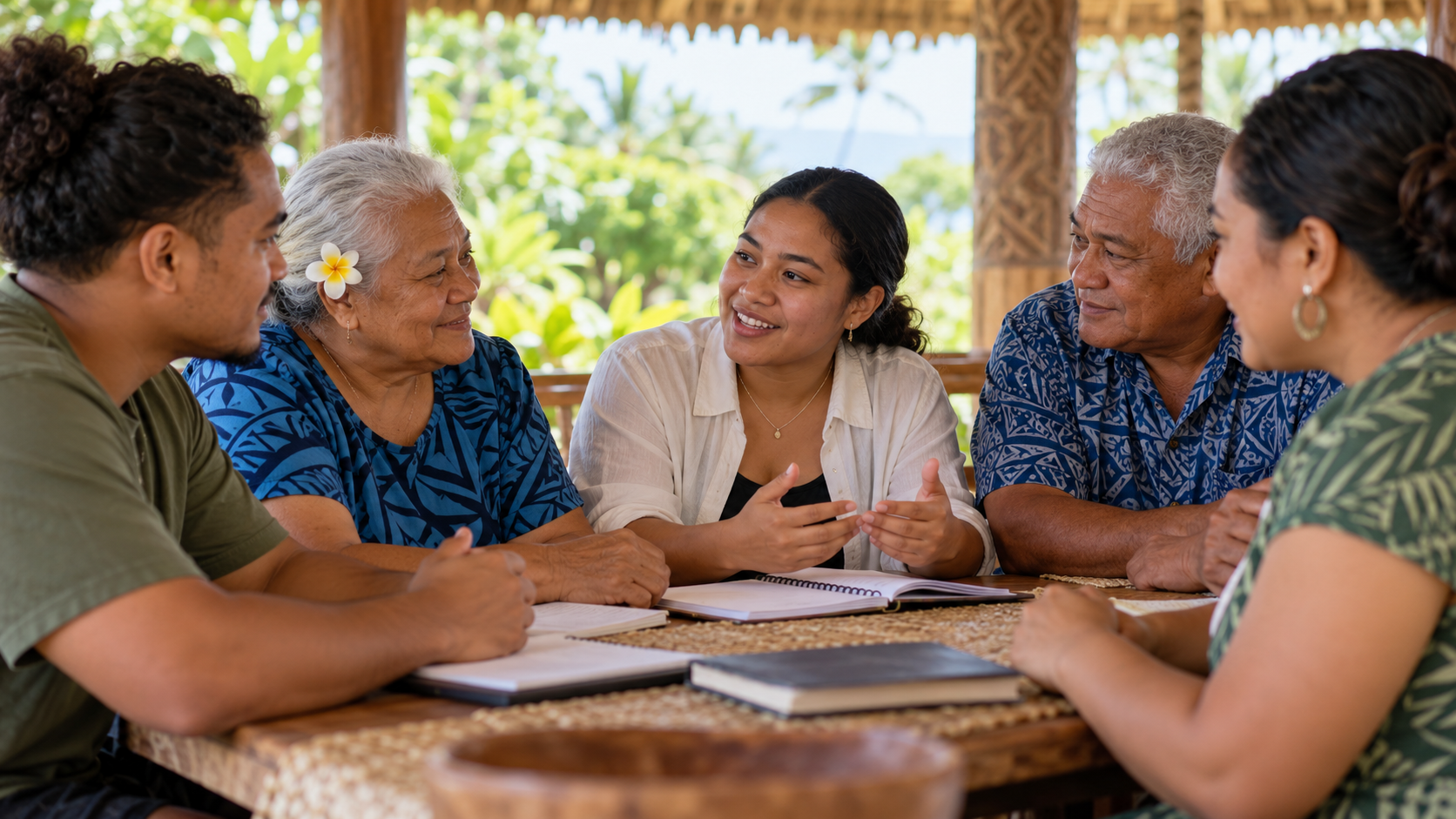
A social worker asks, “What do you need?” A person answers, “My family needs help.” If the worker immediately redirects the conversation to individual independence, an important part of the answer may already have been lost.
Studying Samoan culture invites a different question: What if understanding a person requires understanding the relationships through which that person experiences belonging, responsibility, and wellbeing? For social work education, that question belongs near the beginning.
More than an island postcard
Fa‘asāmoa, often translated as “the Samoan way,” describes a living cultural framework. Family, respect, reciprocal responsibilities, and community participation have important places within it. The ‘āiga extends beyond the small household that many American intake forms assume. The matai system involves titled leadership within family and village life. These institutions help explain why relationships and collective responsibilities can be central to decisions (National Park Service, n.d.).
Language, arts, and intergenerational knowledge can carry cultural meaning. Te Papa’s research examines the many ways Samoan identity is experienced and expressed. For students, the lesson is to ask what a practice means to a person before assigning it a meaning from outside (Museum of New Zealand Te Papa Tongarewa, n.d.).
Samoan people live in Samoa, American Samoa, and communities elsewhere. These settings have different political and service systems. Nor are Samoan, Tongan, Māori, and other Pacific identities interchangeable. Te Papa’s research on Samoan identities emphasizes diversity across locations and experiences. There is no single way that every Samoan person must perform belonging (Museum of New Zealand Te Papa Tongarewa, n.d.).
The person comes with relationships
Tamasese and colleagues (2005) investigated Samoan understandings of mental health through Samoan-language groups facilitated by Samoan researchers. Participants described a relational understanding of self and wellbeing involving balance among spiritual, mental, and physical dimensions. This qualitative study contributes a culturally grounded perspective; it does not establish what every Samoan person believes.
For students, its importance is theoretical. An assessment can become incomplete when it treats relationships only as background information. The question is not simply whether someone has social support. It is also how family connections, responsibilities, ruptures, and belonging help shape the person’s experience.
The same study identified low income, unemployment, housing costs, and cultural marginalization as sources of distress. That is an important correction to any account that explains every difficulty through “culture.” Social work must examine material conditions alongside meanings and relationships (Tamasese et al., 2005).
A little vocabulary, a lot of listening
The Samoan-informed Tautua practice approach describes tautua as service and vā as the relational space between people. Attending to that space involves respect and the responsibilities carried within relationships. Teu le vā concerns tending or restoring relational balance. These concepts invite attention to how a meeting is conducted, not merely what information is collected (Oranga Tamariki, 2025).
A student might therefore ask: “How would you like me to address you?” “Who would you like involved?” “What would respectful help look like?” These are proposed practice questions, not a universal Samoan interview script.
Spirituality and church relationships may also be meaningful. The appropriate question is what they mean to this person, including whether they offer support, create tension, or have little place in the person’s present life. Cultural knowledge should make our questions more thoughtful, not make the answers seem predetermined.
Why this belongs in social work education
First, it challenges students to examine the assumptions inside familiar theories. If a model equates health with separation from family, how will it understand someone who values interdependence? Students should be able to distinguish chosen connection from coercion without declaring either independence or family obligation universally healthy.
Second, it expands who counts as a knowledge producer. Lauta-Mulitalo’s (1998) social work thesis examined fa‘asāmoa as a practical cultural system and described flexible applications by Samoan social workers in Aotearoa New Zealand. Samoan practitioners belong in the curriculum as theorists and teachers, not simply as examples of a population needing services.
Third, it makes research methods visible. Tamasese and colleagues’ (2005) Fa‘afaletui approach used culturally grounded collective discussion. Students can ask whose language is used, who sets the questions, and whose interpretation becomes the finding. One study cannot settle all practice decisions, but it can expose what a familiar research design might miss.
Finally, it gives cultural humility a practical purpose. The National Association of Social Workers (NASW, 2021) calls for self-reflection, learning, and recognition of people as experts on their own cultures. Knowing several cultural terms does not complete that responsibility.
Respecting family while hearing the individual
Consider this fictional teaching example. An adult says, “I want my aunt at the meeting. She helps me explain things.” Another says, “Please do not contact my family.” Neither answer becomes invalid because the person is Samoan.
The worker can ask what each person wants, explain confidentiality and its limits, and discuss who may receive which information. A family member’s standing does not automatically authorize disclosure. A qualified interpreter may be appropriate when language support is needed. Family involvement requires attention to consent, safety, and the applicable professional and legal context (NASW, 2021).
Similarly, respecting culture does not mean excusing abuse or silencing disagreement. Students should practice responding to a young person, an LGBTQ+ person, an elder, or anyone whose wishes differ from influential relatives without assuming that conflict defines Samoan families. The educational task is to hear both belonging and individual experience.
From a classroom topic to a classroom practice
I would build this learning around Samoan-authored work, paid participation by Samoan educators and community partners, and supervised case discussion. Students could compare an individual assessment with a relationship map, identify practical barriers to services, and explain how they would check their interpretation with the person seeking help.
Assessment should ask students to demonstrate their reasoning: What did you assume? What did you ask? Who had decision-making power? What would make you revise your plan? A brief cultural presentation can begin learning, but it cannot substitute for ongoing consultation and accountable practice.
Samoan culture matters to social work education because it offers knowledge about people, relationships, and helping that the profession needs to take seriously. It also asks something useful of the learner: remain curious long enough to discover what your first explanation left out.
