I’ve Seen That Movie Already
When looking back keeps you stuck, and what it means to accept a past you wish had gone differently.
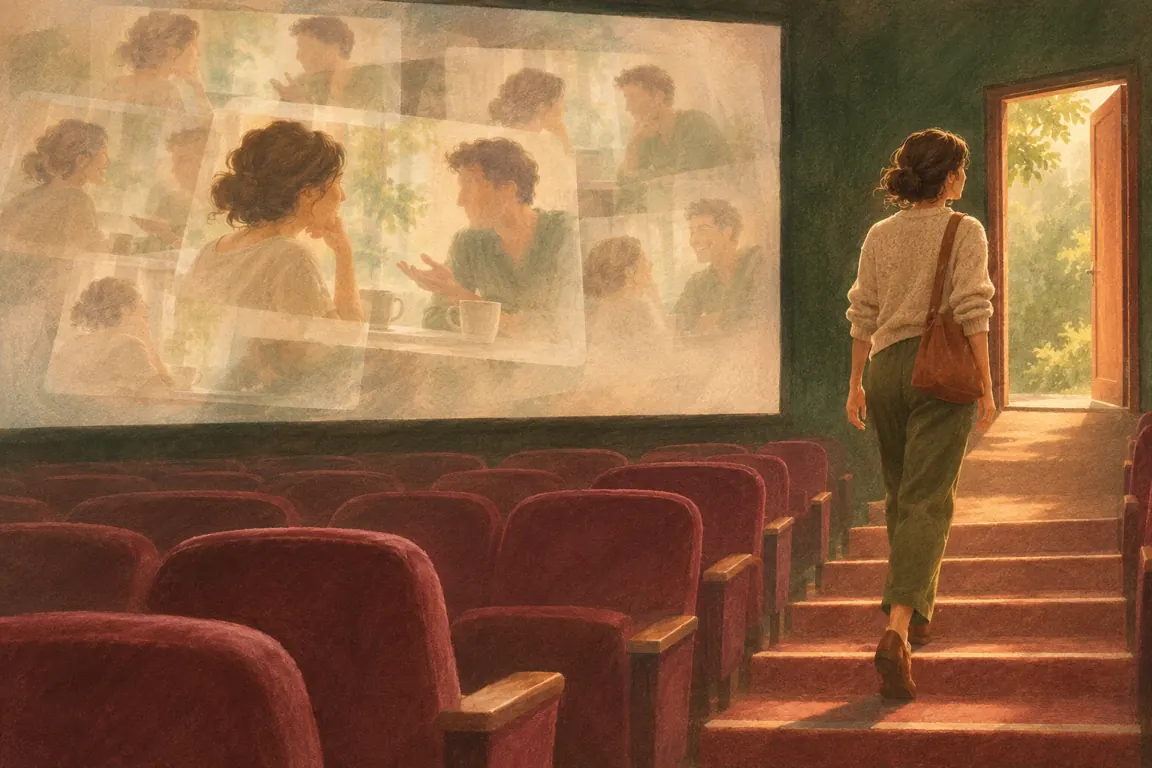
Imagine sitting in a movie theater watching episodes of your own life. One of them is a conversation you wish had gone differently. Another is a loss you’re still trying to make sense of. There may be a scene you’d never have chosen to watch in the first place.
The credits roll. You stay in your seat.
“Why?” you ask.
“I don’t know,” your brain says. “Let’s watch it again. Maybe we missed something.”
So you sit through another showing. You watch the faces more closely. You listen for a different meaning in the same words. Maybe this time you’ll spot the moment you could have changed the ending.
When reflection becomes rumination
Looking back can help you recognize a pattern, grieve a loss, or decide how you want to handle something today. After an argument, for example, you might realize you need to tell someone what hurt you. That kind of reflection gives you somewhere to go. Rumination keeps circling the same distress, often in the form of broad questions like “Why am I like this?” or “Why did I let that happen?” Repetitive negative thinking can deepen a low mood, make problem-solving harder, and increase the risk of depression (Nolen-Hoeksema et al., 2008; Watkins, 2008).
Replaying an episode can feel like work. You may spend an hour on it and end up with the same question, a tighter jaw, and less energy for the rest of your evening. A useful question is, “How is this replay helping me right now?” Give yourself a moment to notice the answer.
The film can change between showings
Memory is a reconstruction. We notice and retain only some of what happens, and later we piece an event together from what we can recall. Expectations, inferences, and things we learn afterward can become mixed with what we originally saw or heard. With time, a detail may feel familiar even when we’ve lost track of where it came from (Loftus, 2005; Schacter, 1999).
Suppose you remember a friend going quiet during a difficult conversation. Later you wonder whether they rolled their eyes. You picture it. Weeks later, the eye roll feels like something you saw. Now it seems to explain the silence, and the story shifts from “My friend went quiet” to “My friend thought I was ridiculous.” The next time you replay the scene, that conclusion may feel like one more reason to judge yourself. In this way, an added detail can give an old loop something new to chew on.
You can take a painful experience seriously while allowing some details to stay uncertain. Try separating what you recall from what you infer. “I remember the silence. I’m unsure about the eye roll. I guessed what they were thinking.” Each sentence makes a different claim.
Accepting what you wish had gone differently
You don’t have to like what you accept. You do have to accept what you don’t like. Here, acceptance means acknowledging that the past happened and that some answers may stay out of reach. You can still call what happened unfair. You can grieve it, hold someone accountable, or set a boundary today. Acceptance gives you room to do those things while letting the past have the ending it already had.
You can also accept what shows up in you today. “I wish that had gone differently. I still feel sad when I think about it.” Research has linked allowing difficult thoughts and feelings without judging them to better psychological health (Ford et al., 2018). Some days, acceptance may be as small as letting yourself feel sad while you go about the evening.
Get up from the chair
Imagine the projector starting again. Feel your feet against the floor and the weight of your hands on the armrests. Picture yourself standing, walking up the aisle, and opening the theater door. As you step outside, tell yourself:
“I’ve seen that movie already. I don’t have to watch it again.”
Then do one ordinary thing in the room you’re actually in. Get a glass of water. Open a window. Finish the conversation you were having before the replay started. If the scene returns, you can notice it and step out again. Memories can come back on their own, especially after trauma. If they’re overwhelming or low mood is interfering with daily life, a mental health professional can help you work through what’s happening at a manageable pace.
You may still wish the movie had ended differently. You can carry that wish with you as you walk out.
The replay loop and the way out
A painful scene comes to mind
“I remember my friend going quiet.”
Stay for another showing
- Search for an answer. “Why did they go quiet?”
- Fill in a gap. “Maybe they rolled their eyes.”
- The guess feels familiar. “I can almost see it now.”
- The story gets harsher. “They must have thought I was ridiculous.”
Feeling worse can send you back to the same question.
Get up and walk out
- Notice the replay. “I’m watching that scene again.”
- Separate memory from guess. “I recall the silence. I’m unsure about the eye roll.”
- Accept what you dislike. “It happened. It hurt. Some details may stay uncertain.”
- Return to the room. “I’ve seen that movie already. I don’t have to watch it again.” Feel your feet on the floor and choose one thing to do now.
Practice with the example above. Which detail did the person remember? Which detail did they imagine? How could they return their attention to the present?
References
- Ford, B. Q., Lam, P., John, O. P., & Mauss, I. B. (2018). The psychological health benefits of accepting negative emotions and thoughts: Laboratory, diary, and longitudinal evidence. Journal of Personality and Social Psychology, 115(6), 1075–1092. https://doi.org/10.1037/pspp0000157
- Loftus, E. F. (2005). Planting misinformation in the human mind: A 30-year investigation of the malleability of memory. Learning & Memory, 12(4), 361–366. https://doi.org/10.1101/lm.94705
- Nolen-Hoeksema, S., Wisco, B. E., & Lyubomirsky, S. (2008). Rethinking rumination. Perspectives on Psychological Science, 3(5), 400–424. https://doi.org/10.1111/j.1745-6924.2008.00088.x
- Schacter, D. L. (1999). The seven sins of memory: Insights from psychology and cognitive neuroscience. American Psychologist, 54(3), 182–203. https://doi.org/10.1037/0003-066X.54.3.182
- Watkins, E. R. (2008). Constructive and unconstructive repetitive thought. Psychological Bulletin, 134(2), 163–206. https://doi.org/10.1037/0033-2909.134.2.163