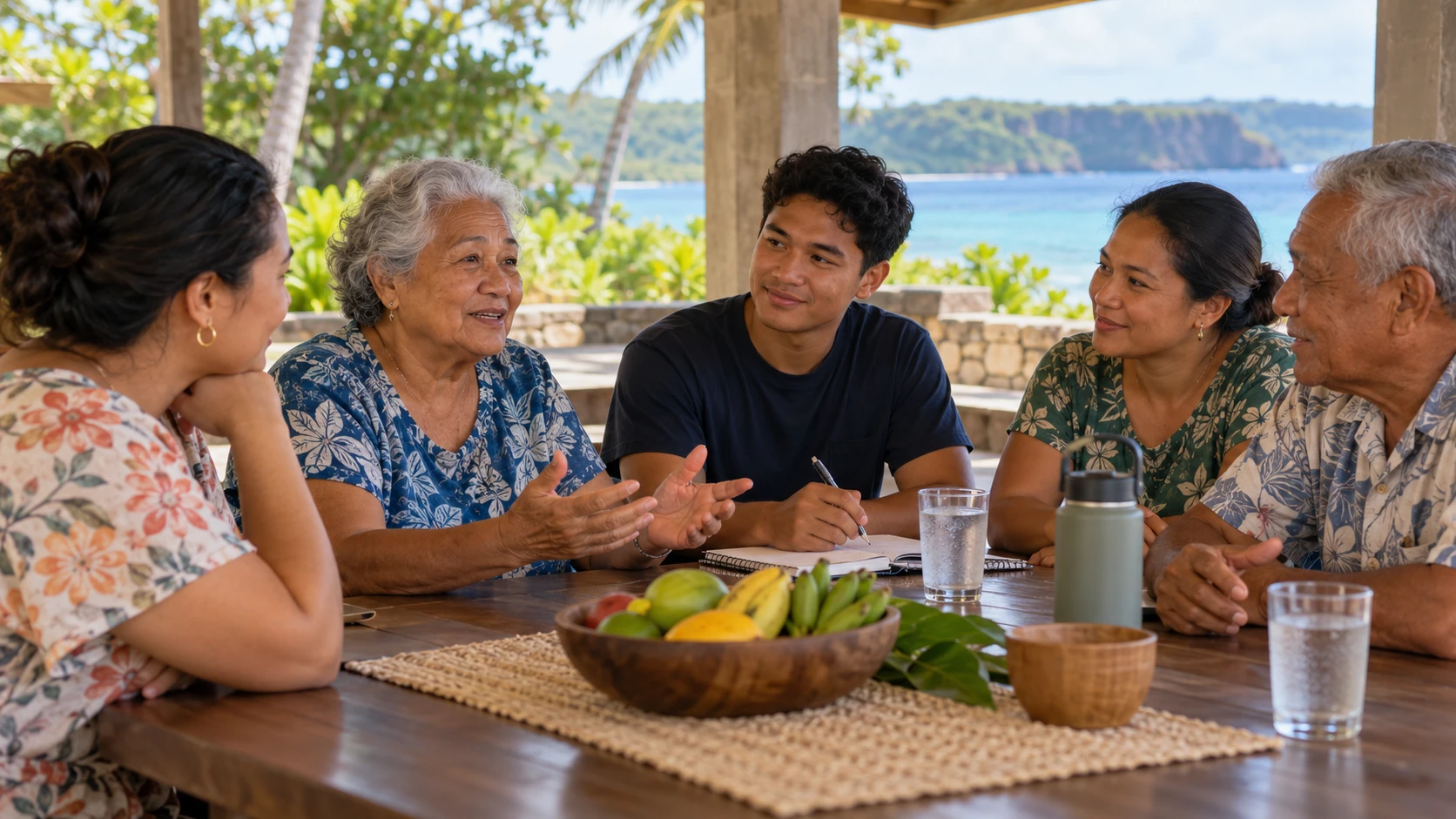
A person asks for help, and the conversation soon reaches beyond that person: a parent who needs care, a relative who offers transportation, a language that feels like home, or a community responsibility that is both meaningful and demanding.
Social work is better equipped to respond when it understands these connections. The cultures of Saipan offer valuable opportunities to learn about mutual aid, belonging, cultural continuity, and the relationship between personal wellbeing and community life.
Saipan is a place of more than one culture
Saipan is the largest island in the Commonwealth of the Northern Mariana Islands, in Micronesia. Its Indigenous CHamoru, also written Chamorro, and Carolinian communities have distinct histories, languages, and traditions. Saipan is also home to people with other cultural backgrounds. “Saipanese” can describe a connection to the island; it should not be treated as a single ethnicity or a uniform set of beliefs.
The National Park Service describes the long CHamoru presence in the Marianas, forced removals during Spanish rule, Carolinian settlement following displacement from island homes, and later German and Japanese administrations. These histories help explain why belonging on Saipan involves relationships among land, language, migration, and political power (National Park Service [NPS], 2019).
Social work begins to benefit from this knowledge when a practitioner replaces a category with a question: “How do you describe your cultural background, and which parts of it matter to the help you want?” Naming the island is a starting point. Understanding the person requires listening.
A person belongs within a network of relationships
A hypothetical learner asks an older person, “Who helps you manage at home?” The answer includes a niece, a neighbor, an adult grandchild, and a friend who provides transportation. An intake form with room for only one emergency contact would capture very little of that support.
This example is an educational application, not a claim that every Saipan household works in the same way. It illustrates the person-in-environment perspective: assessment should examine the relationships and conditions surrounding an individual rather than treating distress as an isolated personal defect.
A social worker can ask who offers practical help, who is trusted with difficult information, and which relationships bring pressure as well as comfort. A relationship map can include relatives, friends, faith communities, cultural groups, and formal services. The individual decides which connections are relevant and whom they want involved.
Interdependence is not automatically a problem to correct. Equally, having many relatives does not establish that someone has reliable or safe support. The useful question is how the network actually functions.
Inafa’maolek and the work of restoring relationships
CHamoru scholar Lilli Perez-Iyechad describes inafa’maolek as a concern with restoring harmony and making things good. Her account emphasizes cooperation, mutuality, respect, and social support extending beyond the nuclear family (Perez-Iyechad, n.d.). This is a CHamoru concept; it should not be assigned to Carolinian traditions as though the two cultures were interchangeable.
For social work, one possible application is to ask what repair would mean within a particular relationship. A young adult and a parent might need help discussing expectations, acknowledging hurt, and agreeing on responsibilities. The goal need not be limited to deciding which person is right.
Restoring a relationship is appropriate only when it respects safety and choice. Harmony cannot mean requiring someone to remain silent about violence, discrimination, exploitation, or abuse. Sometimes a protective boundary, separation, or outside assistance is necessary. These are the author’s practice considerations, not a definition of inafa’maolek.
Chenchule’ makes mutual aid visible
Marsh-Taitano and Aguon (n.d.) describe chenchule’ as a CHamoru system of reciprocal assistance through which families support one another. Contributions can include food, labor, supplies, or money, including around significant life events. The exchange connects support with continuing relationships and obligations.
This perspective can help a social worker notice resources that a conventional service inventory might overlook. A household facing illness may need transportation, meals, child care, or someone to accompany an elder. Formal benefits and community assistance may both be useful.
Yet reciprocity can also raise questions about capacity. A person may value contributing while struggling financially or becoming exhausted. Rather than dismissing the obligation or assuming it is harmless, the worker can ask: “What does giving mean to you? What can you offer without putting your own needs at risk?”
The contribution to social work is a broader understanding of helping: assistance is not always a one-way transfer from a professional to a recipient. People may already participate in systems of care that deserve recognition.
Carolinian belonging deserves its own attention
Carolinian culture should not become a short footnote beneath a discussion of CHamoru values. In her study of Carolinians in Saipan, Kuehling (2012) examines how shared sensory experiences, memories, kinship practices, and everyday routines sustain belonging across displacement. Her account draws attention to forms of cultural continuity that an outsider might not immediately recognize.
The social work application is to inquire about the ordinary experiences through which a person feels at home. These might include familiar language, food, places, household routines, or time with particular people. The answer must come from the individual; it cannot be read from an ethnicity box.
For someone living away from Saipan, practical adjustment and cultural belonging may need attention together. Employment or housing assistance can coexist with a conversation about missing home. No one should have to demonstrate a particular level of cultural knowledge to have their identity respected.
Language and oral history carry more than information
The Northern Marianas Humanities Council preserves a Carolinian oral-history collection of stories, chants, and songs recorded on Satawal in 1982. Told in several dialects, the material concerns voyages to and settlement in the Northern Mariana Islands (Northern Marianas Humanities Council [NMHC], n.d.). This is a concrete example of a local institution protecting community memory.
For social work education, oral history invites students to consider whose account is being heard. An agency file may record an arrival date while leaving out separation, welcome, loss, or the relationships that made the journey possible.
In practice, ask what language a person prefers for discussing difficult experiences. Conversational English does not establish comfort with every technical or emotional term. When needed, arrange appropriate language assistance, clarify confidentiality, and check understanding. Avoid placing the burden of interpreting sensitive discussions on a child.
An individual may prefer English, CHamoru, Carolinian, another language, or a combination. Cultural respect includes accepting that preference without testing whether it is sufficiently traditional.
Teaching across generations can be a community strength
The National Endowment for the Arts documents the work of Felipe and Joseph Ruak and the Talabwog Man Stick Dancers of Saipan. In an interview, Joseph Ruak describes learning dances and chants from his father, concerns about language loss, and his wish that younger people become interested in their cultural background (National Endowment for the Arts [NEA], n.d.). This is a specific community example, not a description of every Carolinian family.
A social work student can learn from the way this example connects teaching, participation, and identity. An elder may be a teacher and knowledge holder as well as someone receiving assistance. A younger person may contribute curiosity, organizational skills, or new ways of recording a family story.
Possible community projects include oral-history activities, arts partnerships, or intergenerational learning chosen and led by local participants. Cultural participation should remain voluntary. It is not a treatment prescribed solely because someone belongs to an ethnic group.
History belongs in the assessment without becoming the whole story
The island’s history of colonial rule, displacement, and war provides context for questions about land, authority, migration, and trust (NPS, 2019). It does not establish that every person has the same emotional response to that history.
A careful question might be: “Are there family experiences with institutions or relocation that would help me understand your concerns?” The person may describe an important connection, or may say that something else matters more.
Historical awareness should make a practitioner more attentive, not more certain. It should also leave room for competence, pleasure, humor, adaptation, and ordinary daily life. Communities are more than accounts of what has harmed them.
Culture and material conditions belong in the same conversation
The CNMI Department of Community and Cultural Affairs places human and social services alongside historic preservation and activities supporting CHamoru and Carolinian heritage in its stated mission (Department of Community and Cultural Affairs [DCCA], n.d.). Its structure offers a local example of social needs and cultural life being addressed within the same public agency.
The educational application is straightforward: do not explain away practical barriers as cultural traits. Someone may miss an appointment because of transportation, work, caregiving, cost, or an inaccessible process. Ask before interpreting the absence as lack of interest.
A service plan might combine benefits assistance, a manageable appointment schedule, language support, and a connection the person values. Agencies can also examine whether their paperwork and hours make participation unnecessarily difficult. Cultural responsiveness involves how services operate, as well as how respectfully a worker speaks.
Respect does not remove the individual’s voice
A hypothetical young adult says, “I want my aunt involved, but I do not want her to know everything.” A culturally responsive response is not to choose between family involvement and privacy. It is to clarify what involvement the individual wants and what information may be shared.
“What would you like us to discuss together?” the worker might ask. “What would you prefer to discuss privately?” The answer can guide a conversation about roles, consent, and the applicable limits of confidentiality.
This example should not be read as a claim that Saipan families are unusually intrusive. Similar decisions occur across communities. Its purpose is to show that respecting relationships and respecting personal choice can be pursued together.
Listening also requires room for differences involving generation, religion, gender, sexual orientation, disability, class, and family experience. A person need not agree with every family expectation to have a meaningful cultural identity.
What students and practitioners can do differently
The NASW Code of Ethics identifies cultural humility with self-reflection, self-correction, lifelong learning, and recognition of individuals as experts on their own cultures. It also calls for attention to oppression and inequity (National Association of Social Workers [NASW], 2021, Standard 1.05). Learning a few cultural terms does not complete that responsibility.
An assignment about Saipan can begin with sources created by community institutions, scholars, and cultural practitioners. Students can distinguish an account of one village or family from evidence about a whole population. They can also identify what remains uncertain rather than filling gaps with assumptions.
With permission and appropriate compensation, local educators and cultural consultants can help agencies evaluate their approach. Their contribution should shape the work rather than merely decorate a presentation.
In an encounter, useful questions include: “What have I misunderstood?” “Who would you like included?” “Which expectations matter to you?” and “What would make this plan fit your life?” These questions turn cultural knowledge into an invitation for correction.
Curiosity is part of culturally responsive practice
The cultures of Saipan contribute to social work by inviting fuller attention to relationships, mutual assistance, continuity, community knowledge, and the conditions in which people live. They also remind practitioners to distinguish between learning about a culture and knowing a particular person.
A worker who learns about reciprocity can ask better questions about support. A worker who listens to oral history can recognize that a short intake answer may carry a much longer story. A worker who respects community teaching can notice expertise outside professional credentials.
These are opportunities for social work to become more accurate and collaborative. They are not reasons to romanticize island life or replace evidence-based care with assumptions about tradition.
We can arrive informed and remain curious. The most useful next question may be simple: “What would you like me to understand about your life before we decide how to help?”
