
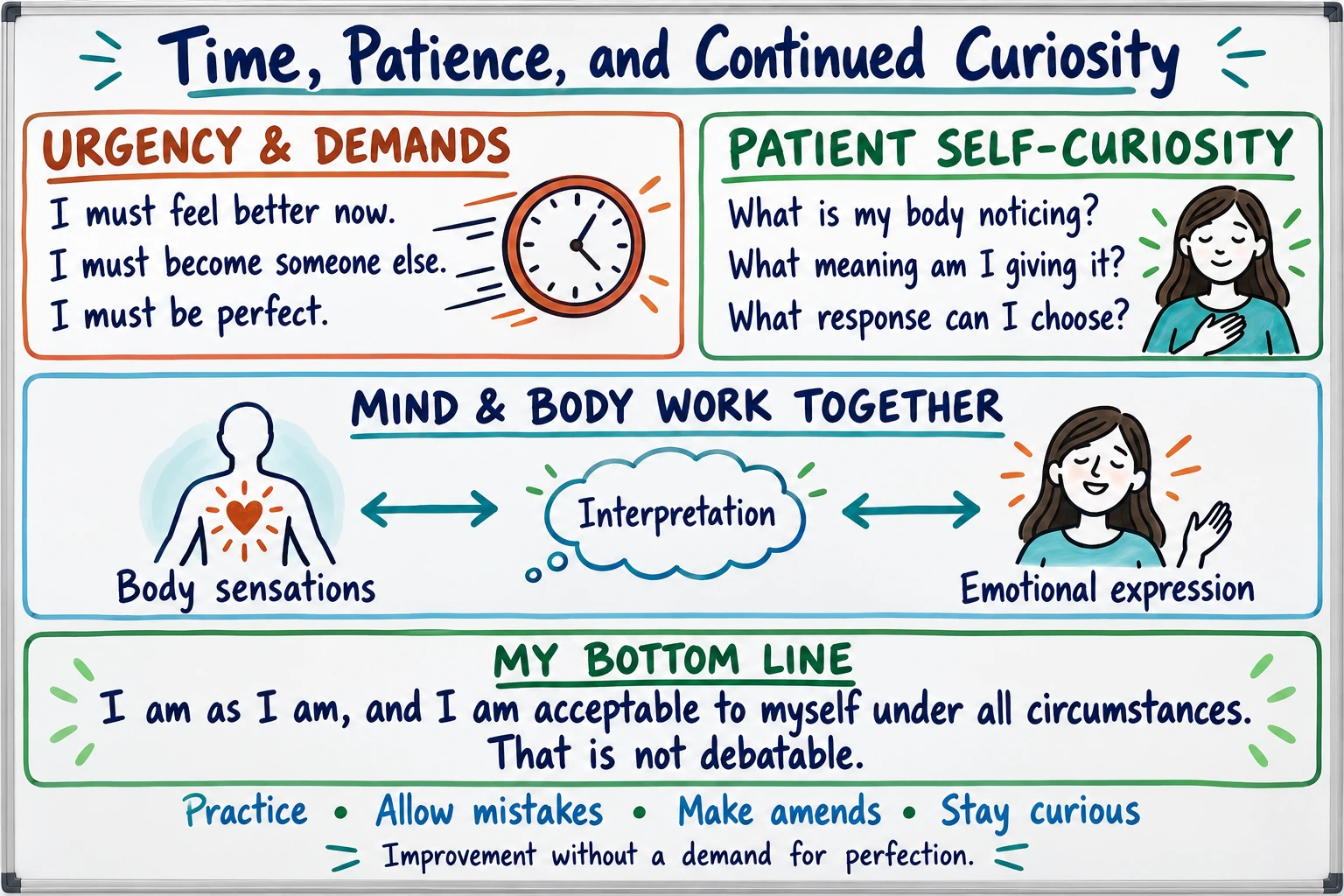
Emotional intelligence improvement requires time, patience, and continued curiosity. It asks us to become familiar with ourselves: how our bodies respond, how our minds interpret those responses, and how we give emotion its expression. Urgency can interfere with this discovery. When we insist that we must feel differently, improve immediately, or become someone else, we can turn self-awareness into another occasion for judging ourselves.
There is a difference between becoming curious about ourselves and demanding that we change. Curiosity allows us to examine an experience without making our acceptability depend on what we find. A demand for change can begin with the assumption that who we are is insufficient. From that position, even improvement becomes a test we are afraid to fail.
The practice of emotional intelligence begins with a more accepting foundation: I am a human being whose experiences are available for examination. I can learn about myself without first rejecting myself.
Mind and body participate together in emotional experience. A tightening chest, a restless stomach, a change in breathing, or tension in the jaw may become noticeable before we can explain what is happening. We interpret these sensations within the circumstances of our lives. Our memories, expectations, and beliefs contribute to the meaning we give them. That meaning, in turn, can influence what happens next in the body and how we behave.
In this sense, emotion is an animation of thought. What we believe becomes visible and audible through our posture, our expression, our voice, and our actions. At the same time, the body participates in shaping the thoughts we notice. Continued curiosity invites us to examine this exchange without assuming that we should already understand it.
We might ask: What am I noticing in my body? What meaning am I giving this situation? What am I predicting? What am I insisting must happen? These questions are useful when they arise from an interest in understanding. They become less useful when they are accusations disguised as questions: Why am I still like this? Why haven’t I learned? What is wrong with me?
Urgency places a deadline on discovery. It tells us that discomfort must end now and that an emotional response should disappear because we have recognized it. But recognition does not guarantee immediate relief. We may understand a familiar pattern and still participate in it. We may notice our impatience only after speaking impatiently. Awareness sometimes arrives afterward. That, too, gives us something to examine.
The word trying can carry a similar demand. “I am trying to be calm” may quietly become “I must be calm, and I am failing if I am not.” Effort itself is not the difficulty. The difficulty develops when effort becomes a struggle to force an internal experience into obedience. We can practice pausing, listening, and reconsidering without demanding that these practices produce a particular feeling on command.
Patience allows learning to remain unfinished.
Continued self-awareness may result in some degree of improved emotional management. We may recognize an interpretation sooner, pause before acting, or recover more readily after an outburst. Yet none of these possibilities establishes a path to perfection. A lifetime of attention will still leave us capable of misunderstanding, reacting hastily, and disappointing ourselves.
Acceptance of fallibility belongs within the practice. It cannot be reserved for the day we finally stop making mistakes. We are fallible while learning, while improving, and while believing we should know better. Being willing to be human means allowing this knowledge to apply to ourselves.
A useful reminder is:
“I am as I am, and I am acceptable to myself under all circumstances. That is not debatable.”
This is my bottom line. My behavior remains open to examination. My conclusions remain open to correction. I can acknowledge harm, take responsibility, and make amends. My acceptance of myself does not have to be renegotiated each time I discover something I would prefer to have done differently.
With that foundation, self-curiosity becomes more honest. I have less reason to hide an uncomfortable thought from myself if discovering it will not become grounds for rejecting my whole person. I can examine jealousy, fear, resentment, or impatience without turning any one experience into a final definition of who I am.
The demand to change often introduces a comparison: who I am against who I believe I ought to be. When that comparison requires me to negate myself in favor of an imagined, more acceptable person, it works against the emotional intelligence I hope to improve. I become occupied with escaping myself rather than understanding myself.
Improvement can take place within acceptance. I can develop a different response while remaining the same human being, worthy of my own acceptance throughout the process. I do not need to become someone else to listen more carefully, question an assumption, or choose my next action with greater awareness.
Enlightenment, understood this way, may be a gradual familiarity with our own humanity. We become more able to notice how we participate in our experiences. We recognize that a thought can be examined, a demand can be reconsidered, and an emotional expression can be understood. We also recognize the limits of our knowledge and remain willing to discover more.
There is no final examination that certifies us as perfectly emotionally intelligent. There is the ordinary practice of noticing, questioning, accepting, and returning to curiosity. Some days that practice comes easily. Other days we remember it only after we have acted.
Time gives us experience. Patience gives us room to examine it. Continued curiosity gives us a reason to keep learning.
And through it all, the foundation remains: I am as I am. I am acceptable to myself under all circumstances. From here, I can be curious.
A moment for curiosity: 15-question quiz
Choose one answer for each question, then select “View results.” This is a review of the essay’s perspective, not a measure of your worth or a clinical assessment. There is no timer. Answers stay in this page and are not submitted or saved.
Read the answer key and explanations
- B. Time, patience, and continued curiosity
The essay presents improvement as an ongoing practice of patient self-discovery.
- D. It turns discovery into a demand for immediate improvement
A deadline for feeling differently can make awareness another occasion for self-judgment.
- A. What meaning am I giving this situation?
Curiosity examines meaning without condemning the whole person.
- C. They participate together and influence one another
Bodily sensations, interpretations, and expression interact throughout emotional experience.
- B. Beliefs can find expression in posture, voice, and actions
The phrase is the essay’s way of describing how meaning becomes expressed; the body also helps shape thought.
- D. Examine what happened and take responsibility
Awareness can arrive afterward and still support learning and repair.
- A. It may become a demand to feel calm and a judgment of failure
The essay questions coercive demands, while allowing effort, pausing, and practice.
- C. Learning to remain unfinished
Patience makes room for an ongoing process without requiring immediate mastery.
- B. Recognizing an interpretation sooner and pausing before acting
Improvement may involve earlier noticing, a pause, or a more ready recovery.
- D. Being willing to remain human while learning
Fallibility is part of practice, including when we believe we should already know better.
- A. I am acceptable to myself under all circumstances
Unconditional self-acceptance is the foundation rather than a reward for performance.
- C. By accepting oneself while correcting behavior and making amends
The essay separates acceptance of the person from evaluation of actions and conclusions.
- B. Negating oneself in favor of an imagined, more acceptable person
The problem is a comparison that makes self-rejection the motivation for improvement.
- D. A gradual familiarity with one’s humanity and limits
Understanding develops while curiosity and openness to further discovery remain.
- A. I can accept myself, examine my response, and choose what to do next
Acceptance, examination, and deliberate action can take place together without a demand for perfection.