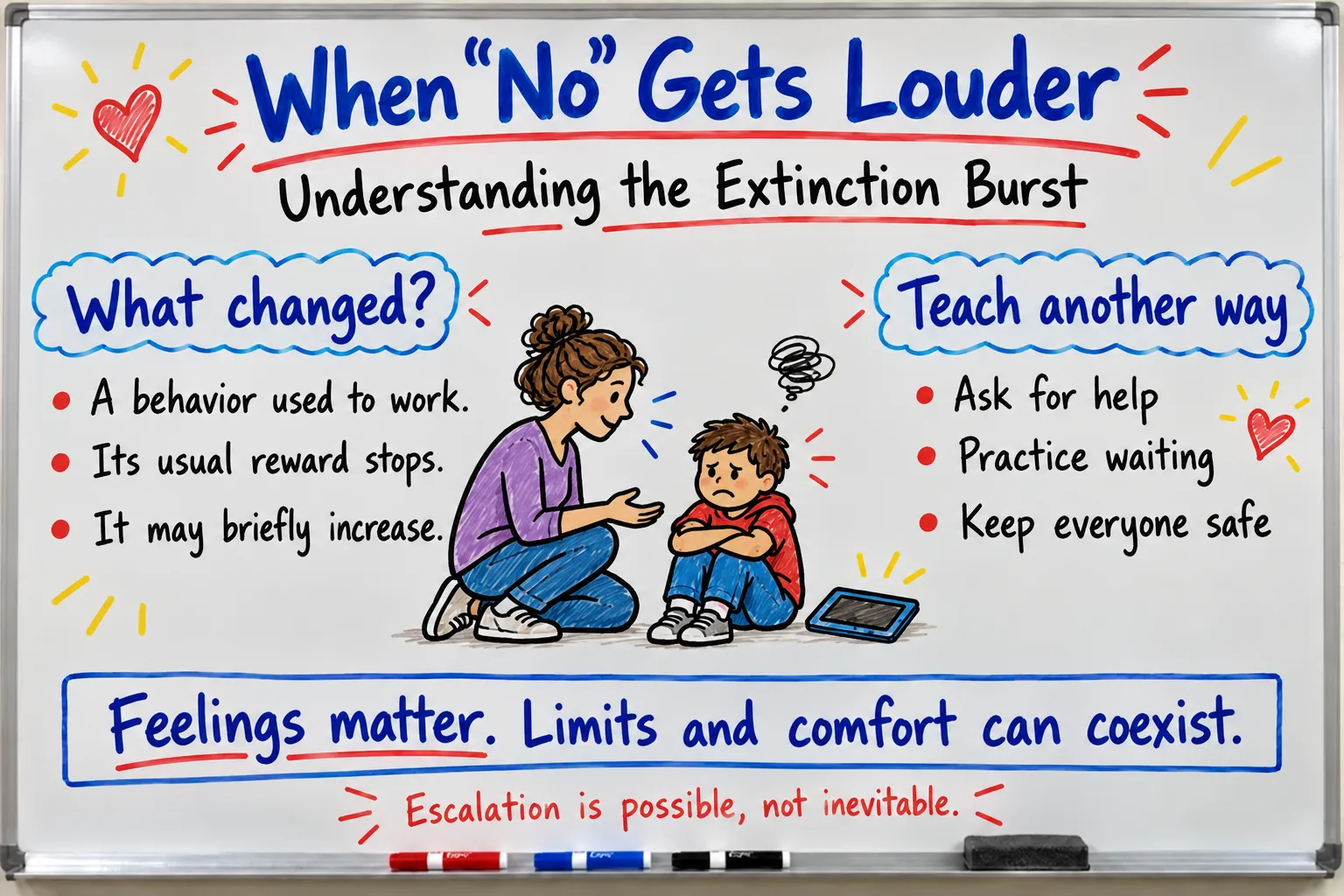
A child reaches for something they want. The parent says no. The child whines. The answer remains no. The child kicks, screams, or hits. Eventually, the parent gives the child what they wanted.
The argument ends. Peace returns. But something else may have happened: a lesson has been learned.
The child may have learned that reaching did not work, whining did not work, and screaming did not work—but hitting did. The parent may have learned that giving in stops the confrontation.
When these consequences make the same responses more likely in the future, both sides of the interaction have been reinforced. Research on coercive family processes describes how efforts to escape unpleasant interactions can contribute to persistent patterns of conflict between children and caregivers (Smith et al., 2014).
Neither person needs to recognize this learning for it to influence what happens next.
This opening illustrates how escalation can become effective. An extinction burst is a related but more specific process: what may happen when a behavior that previously worked stops producing its usual result.
Climbing the pyramid
I picture this process as climbing a pyramid. Near the bottom are less intense attempts to obtain something. As those attempts fail, the child may move higher, repeating a behavior more forcefully or trying another behavior.
The sequence is not the same for every child. Some repeat their earlier behaviors, some combine them, and some move quickly to a behavior that has worked before. A child who has repeatedly obtained something after hitting may begin hitting sooner during the next disagreement.
This does not mean that every child is deliberately calculating how to control a parent. Nor does every outburst serve the same purpose. Similar behaviors can produce different consequences: attention, access to something, or escape from a demand. Research demonstrates that effective extinction procedures must address the particular consequence maintaining the behavior; simply withholding attention does not address every behavioral function (Iwata et al., 1994).
A child may also be experiencing pain, exhaustion, confusion, or overwhelming discomfort. Understanding the circumstances matters before deciding how to respond.
The pyramid is my teaching metaphor, not a validated model or a fixed developmental sequence. Children do not inevitably progress from whining to violence, and dangerous behavior should never be treated as a necessary stage of learning.
What an extinction burst actually means
In behavioral psychology, extinction refers to discontinuing the reinforcement that previously maintained a behavior. It also describes the resulting reduction in responding over time. An extinction burst is an initial increase in the target behavior after its usual reinforcement is withdrawn (Lerman & Iwata, 1995).
For example, a child whose screaming has repeatedly resulted in additional screen time may initially scream more when screaming no longer extends screen time. Aggression or other responses can also occur during extinction, but these are not automatically the same phenomenon as an increase in the original target behavior (Lerman et al., 1999).
Escalation alone does not establish that an extinction burst is occurring. There must be a relevant history: a behavior previously produced reinforcement, and that reinforcement is now being discontinued.
An extinction burst is possible, not inevitable. In an analysis of 113 sets of extinction data, researchers identified bursts in 24% of cases. These were published treatment data, not a representative sample of everyday parent–child disagreements. The percentage therefore cannot predict what a particular child will do at home. It does, however, challenge the assumption that behavior must become substantially worse before improving (Lerman & Iwata, 1995).
Extinction also does not mean withdrawing affection, withholding essential care, or refusing to respond to danger.
The message I want a child to receive is:
“Hurting, screaming, or destroying things will not obtain this privilege. You have other ways to communicate, receive help, and manage disappointment.”
Why parents give in
Parents often give in because they are overwhelmed. They may be working, preparing dinner, caring for another child, or trying to get somewhere on time. In public, embarrassment and the reactions of others can add pressure.
Giving in offers immediate relief. The screaming stops. The parent can return to the task that felt more urgent.
From a learning perspective, receiving the desired item may positively reinforce the child’s escalation. Ending the confrontation may negatively reinforce the parent’s decision to give in. Negative reinforcement means that a response becomes more likely because something unpleasant is removed; it does not mean punishment. This mutual relief helps explain how coercive interactions can become established (Smith et al., 2014).
This explanation is not an accusation. It describes how understandable efforts to end a difficult moment can create a more difficult pattern.
Occasionally giving in after prolonged escalation may also help maintain persistence. A history of intermittent reinforcement can make behavior more resistant to extinction, although its effects depend on the circumstances (Lerman & Iwata, 1996).
Parents therefore need more than determination. They need realistic expectations, support, and a plan they can carry out.
Crossing the peak requires teaching
In the pyramid image, crossing the peak represents a change in learning: the old behavior becomes less effective, and more constructive behavior becomes useful.
But there is no guaranteed peak that parents must endure before improvement begins. Removing a payoff does not, by itself, teach a child how to wait, ask for help, negotiate appropriately, or manage disappointment.
Research offers a more constructive direction. Carr and Durand (1985) demonstrated that teaching communication responses that served the same function as challenging behavior could reduce that behavior in four children with developmental disabilities. Later work describes how functional communication training can be individualized around the reason a behavior occurs (Tiger et al., 2008).
A parent might teach a child to say:
“I’m disappointed.”
“Can you tell me when I can have another turn?”
“I need help calming down.”
“Can I choose something else?”
The alternative must be within the child’s abilities. Communication may involve speech, gestures, pictures, or a communication device. Early teaching should make the new response easy and reliably useful; tolerating delays and unavailable requests may require additional, gradual instruction (Tiger et al., 2008).
Politeness does not guarantee that the original answer becomes yes. Appropriate communication can receive acknowledgment, help, choices, and opportunities available within the limit.
“You asked respectfully. The tablet is finished for tonight. You can choose a book, and I can sit with you.”
Research on the treatment of self-injurious behavior also found fewer extinction bursts and increases in aggression when extinction was combined with other procedures than when used alone. Because these were specialized clinical cases, the findings support caution and individualized planning rather than a universal home procedure (Lerman et al., 1999).
The practical goal is to help the child respond safely and effectively while upset. Success does not require the child to stop feeling disappointed.
A parent’s preparation plan
The following framework is an educational starting point to adapt to the child’s age, abilities, needs, and behavioral history.
1. Understand the pattern before changing it.
Write down what usually happens before the behavior, what the child does, and what follows. What might the child gain or avoid? Also consider pain, hunger, fatigue, anxiety, sensory overload, and difficulty understanding the request.
These observations can suggest patterns; they do not establish a behavioral function with certainty. Do not deliberately provoke dangerous behavior to test an explanation.
The CDC recommends planned attention withdrawal only for minor, safe, attention-seeking behavior—not behavior arising from unmet needs or genuine distress (Centers for Disease Control and Prevention [CDC], 2026).
2. Choose one reasonable limit.
Start with a manageable situation rather than trying to change every difficult behavior at once. Explain the limit when everyone is calm. Use language the child understands, and provide predictable warnings for transitions.
Saying no and meaning it begins with choosing a no that is reasonable and possible to maintain. New information can justify reconsidering a decision; changing course thoughtfully is different from surrendering solely to stop escalation.
Do not make food needed for nourishment, access to a toilet, medical care, protection, or emotional support contingent on compliance.
3. Teach and practice the alternative first.
Practice asking, waiting briefly, choosing an alternative, and requesting help. Make the first steps achievable. A child who cannot yet wait several minutes may need to begin with a few seconds.
Recognize progress specifically:
“You were disappointed and kept your hands safe.”
Do not require perfect calm before acknowledging an appropriate attempt to communicate. Teaching should fit the child’s current communication skills and gradually build greater independence (Tiger et al., 2008).
4. Prepare the environment without creating a confrontation.
Before a predictable difficult transition, move readily throwable breakables and heavy objects out of the immediate area. Secure medications, sharp objects, firearms, and other hazards. Keep exits clear and plan where siblings and pets can move safely.
An ordinary home cannot be made entirely free of objects that could cause harm. Environmental preparation reduces risk; it does not make severe aggression safe to ignore.
If serious violence, self-injury, dangerous running away, or major property destruction is foreseeable, obtain an individualized assessment and safety plan from a qualified clinician before attempting an extinction procedure.
5. Prepare the adults.
Agree on the limit, the replacement behavior, and who will supervise. Decide who will help other children and who can provide backup.
Parents should also identify their own warning signs: shouting, threatening, feeling trapped, or becoming too angry to respond safely. A plan needs a way for an overwhelmed adult to obtain help while ensuring the child remains supervised.
Consistency requires a shared, workable response. It should never become a contest over which person can endure more distress.
6. Respond briefly and calmly.
During a safe disagreement, avoid repeated explanations and extended arguments. A short statement may be enough:
“I understand that you want it. The answer is no. I can help you with the disappointment.”
For an agreed minor attention-seeking behavior, briefly withdrawing attention may be appropriate. Continue supervision and return attention promptly when appropriate behavior appears. Dangerous or destructive behavior requires intervention; distress may require comfort and help regulating emotions (CDC, 2026).
Comfort and a reasonable limit can coexist.
7. Establish clear safety thresholds.
The plan must say when the behavioral exercise ends and the safety response begins.
Hitting, dangerous throwing, self-injury, and unsafe attempts to leave require protective action. Move others away, maintain a safe distance, and obtain assistance as needed. Do not improvise restraint, lock a child in a room, or block emergency exits.
Suicide statements must never be dismissed as manipulation or ignored as an extinction burst. All suicide talk requires serious attention. Stay with a child who says they intend to kill themselves, obtain urgent assessment, and use emergency services when danger is immediate (National Institute of Mental Health, 2023).
Responding to danger is compatible with maintaining a reasonable limit. However, immediate safety takes priority over completing a behavioral procedure.
8. Review what happened and adjust.
After everyone has recovered, briefly discuss the event without shaming the child. Describe the unsafe behavior, practice an alternative, and arrange age-appropriate repair where needed.
“You threw the toy. That could hurt someone. Let’s practice asking for help. Then we will put things back together.”
Record whether episodes are becoming less frequent, shorter, or safer, and whether replacement skills are increasing.
Worsening danger is a reason to reassess the plan—not evidence that success must be near.
Improvement may be uneven
A single successful evening does not mean that learning is complete. Previously reduced behavior can return after time has passed or when circumstances change. The extinction literature describes several forms of recurrence, reminding us that improvement does not necessarily erase earlier learning (Lerman & Iwata, 1996).
A setback is an opportunity to review the circumstances, the child’s needs, and whether the alternative response remains useful. It is not proof that the child is bad or that the parent has failed.
If episodes remain frequent, impair daily life, or become more dangerous, seek further assessment rather than repeatedly intensifying the same approach.
What the child needs to learn
A child does not need to learn that their feelings are unimportant, that asking is pointless, or that a parent’s affection disappears during disagreement.
The child needs opportunities to learn that disappointment is manageable, communication is useful, and harmful behavior does not determine access to privileges.
The parent’s task is to support those lessons through reasonable limits, emotional availability, and repeated opportunities to practice.
“I care about how you feel. I will help you stay safe. The answer is no.”
References
Carr, E. G., & Durand, V. M. (1985). Reducing behavior problems through functional communication training. Journal of Applied Behavior Analysis, 18(2), 111–126. https://doi.org/10.1901/jaba.1985.18-111
Centers for Disease Control and Prevention. (2026, April 30). Tips for redirecting your attention. https://www.cdc.gov/parenting-toddlers/responding-to-behavior/ignoring.html
Iwata, B. A., Pace, G. M., Cowdery, G. E., & Miltenberger, R. G. (1994). What makes extinction work: An analysis of procedural form and function. Journal of Applied Behavior Analysis, 27(1), 131–144. https://doi.org/10.1901/jaba.1994.27-131
Lerman, D. C., & Iwata, B. A. (1995). Prevalence of the extinction burst and its attenuation during treatment. Journal of Applied Behavior Analysis, 28(1), 93–94. https://doi.org/10.1901/jaba.1995.28-93
Lerman, D. C., & Iwata, B. A. (1996). Developing a technology for the use of operant extinction in clinical settings: An examination of basic and applied research. Journal of Applied Behavior Analysis, 29(3), 345–382. https://doi.org/10.1901/jaba.1996.29-345
Lerman, D. C., Iwata, B. A., & Wallace, M. D. (1999). Side effects of extinction: Prevalence of bursting and aggression during the treatment of self-injurious behavior. Journal of Applied Behavior Analysis, 32(1), 1–8. https://doi.org/10.1901/jaba.1999.32-1
National Institute of Mental Health. (2023). Frequently asked questions about suicide. https://www.nimh.nih.gov/health/publications/suicide-faq
Smith, J. D., Dishion, T. J., Shaw, D. S., Wilson, M. N., Winter, C. C., & Patterson, G. R. (2014). Coercive family process and early-onset conduct problems from age 2 to school entry. Development and Psychopathology, 26(4, Pt. 1), 917–932. https://doi.org/10.1017/S0954579414000169
Tiger, J. H., Hanley, G. P., & Bruzek, J. (2008). Functional communication training: A review and practical guide. Behavior Analysis in Practice, 1(1), 16–23. https://doi.org/10.1007/BF03391716